Showing posts with label I/D. Show all posts

Thursday, March 27, 2014

I/D #3 Unit Q Pythagorean Derivations

1. Where does where sin^2x+cos^2x=1 come from to begin with (think Unit Circle!). You should be referring to Unit Circle ratios and the Pythagorean Theorem in your explanation.

Sin^2x +cos^2x=1 comes from the Pythagorean Theorem. Since Sine is equal to y over r and that is eqaul to y^2. Cosine is equal to x over r, which in referring to the Pythagorean Theorem is eqaul to x^2. When you put this together you have x/r^2 + y/r^2 = 1 or sin^2x + cos^2x = 1.
When deriving the two remaining Pythagorean Theorems you have Tan^2theta +1 = Sec^2theta and 1 + Cot^2theta = Cosecant^2theta. For the first one you have tanx= sinx/cosx then you multiply tanx by tanx=sinx/cosx times sinx/cosx you will be left with Tan^2x = Sin^2x/Cos^2x. For the second one you will do the same but have One/tan and one/sin to work with instead of the other two.

2. The connections that I see between Units N, O, P, and Q so far are…

The connections that I see so far are that the unit circle expands so much farther than I thought. I see that the ratios of Sin,Cos, and Tan can be used in many numerous equations across the unit of trigonometry.

3. If I had to describe trigonometry in THREE words, they would be…
Difficult and Tedious


Wednesday, March 5, 2014

I/D #2 How can we derive the patterns from our special right triangles?

Inquiry Activity Summary
In class I completed a worksheet in which I had to find as to why and how I would find the special patterns of the two special right triangles. One of them being the thirty, sixty, ninety, and the other being the forty five forty five ninety triangle.

For the forty five, forty five, ninety triangle I drew a dotted line diagonally down the middle of the square. A square has a ninety degree angle cutting this down the middle creates a forty five degree angle. After you have done this you create the special triangle. Label your special triangle correctly. Label the shared side as Y, then label X . You are given a side length of one to work with. After you label both of your sides with the given, you use the Pythagorean Theorem to find the length of the hypotenuse. You should set this up as one squared plus one squared equals c squared, as an answer you should get radical two as an answer.  From this we derive the special pattern N, N, N radical 2. The reason for n is due to the fact that it can stand for any given value in the world.

For the thirty, sixty, ninety triangle I drew a dotted line straight down the middle of the triangle to split it in half. I label the shared line with Y and then I label X. You are given a side length of one to label the sides with.  When you do this you end up with the angles of thirty, sixty, and ninety. When this happens the side length that you were given of one changes to one half. You now have one and one half to work with for the Pythagorean Theorem You set it up with one squared plus b squared equals one half squared. You should end up with the answer of radical three over two for the side of Y. Now we can add N into the pattern. When we do this you can derive the special pattern you now have 2N, N, and N radical three. The reason for N is because it can stand for any number in the world, it has infinite values for it.


Inquiry Activity Reflection
Something I never noticed before about special right triangles is the N can stand for any value in the world.
Being able to derive these patterns myself aids in my learning because I can now fully understand how and where these patterns come from.


Sunday, February 23, 2014

ID # 1: Unit N Concept 7 How do SRT and UC relate?

Inquiry Summary Activity
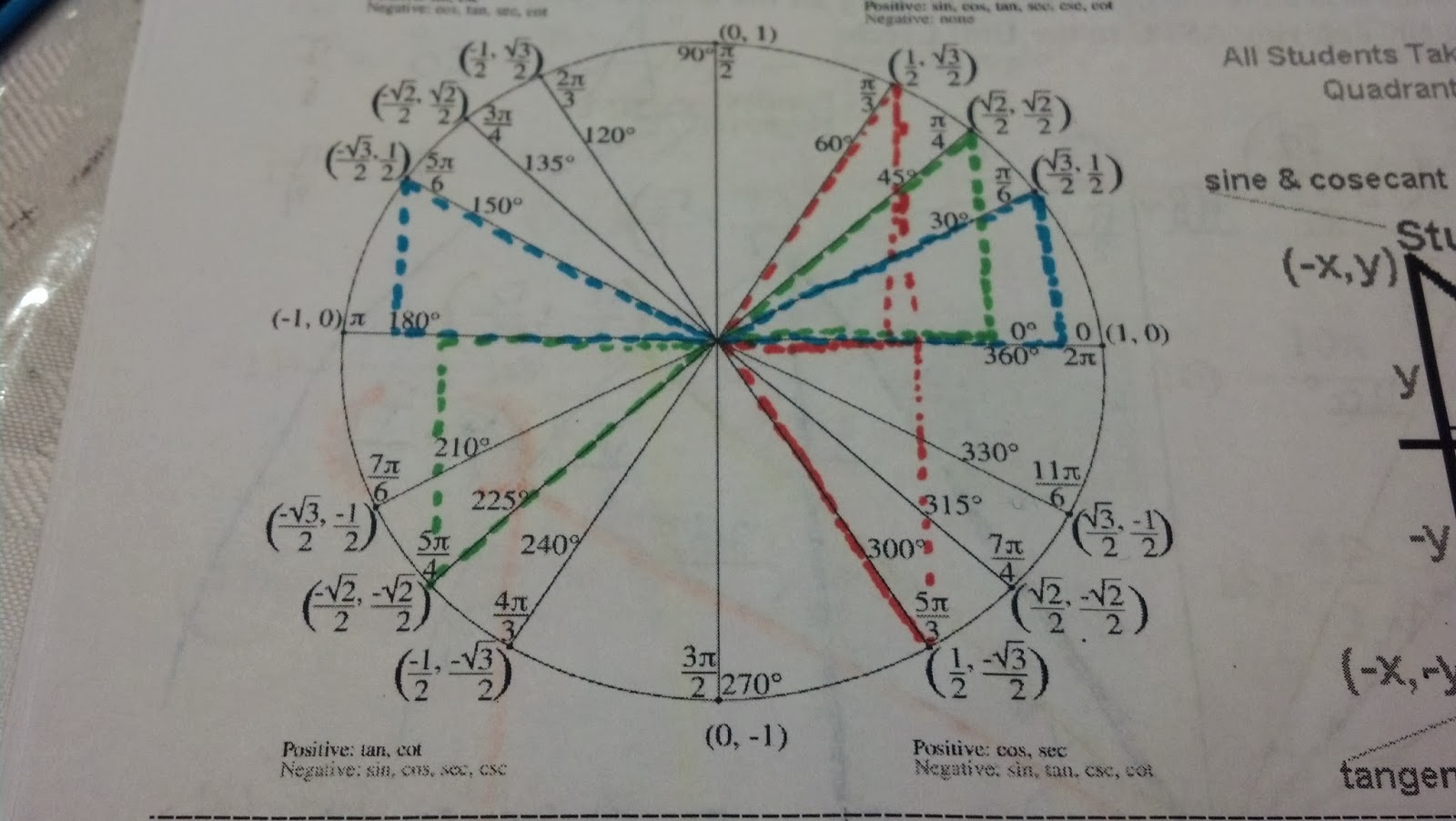
In class on Wednesday I completed a special triangle activity. The activity was based on the three types of special triangles that are found in math. Those three triangles are a thirty, sixty, and ninety degree triangle and the other one is a forty five, forty five, ninety degree triangle, the third ons is a varitation of the thirty sixty ninety triangle.

The thirty degree triangle is the one that matches up with the ordered pair of radical three over two and one half. It has a radian measure of pi over six.

The forty five degree triangle is the one that matches up with radical two over two and radical two over two. It has a radian measure of pi over four.

The sixty degree trianlge is the one that matches up with the ordered pair of one half and radical three over two.


This activity helps with the unit circle because these three triangles are what make up the unit circle. Once you find these three triangles you can find the other three quadrants of the circle. Simply add and simplify all the way around the circle.The triangle always has to be in the first quadrant. If you were to draw these triangles in any of the other quadrants the values of the degrees would go up, the radians would also increase, and lastly the ordered pairs would differ from positive and negative.


As you can see the radians change and the degrees go up according the the revolution of the circle, zero to three sixty. The thirty degree triangle is now at one hundred and fifty degrees with a radian measure of five pi over six, this being in the second quadrant. The forty five triangle is now at two hundred and twenty five degrees and has a radian measure of five pi over four, this being in the third quadrant. The sixty degree triangle is now at three hundred degrees and now has a radian measure of five pi over three, this being the fourth quadrant. Another thing to notice is how the ordered pairs transition from positive to negative according to the quadrant of the unit circle.

The coolest thing I learned from this activity was how by finding one part of the circle one can easily solve for the entire unit circle.
This activity will help me in this unit because I will be able to solve for the rest of the unit with ease or if not at least have a tool to refer to in case I get stuck with my work.
Something I never realized before about special right triangles and the unit circle is, this whole concept is new to me so its all pretty intresting.